

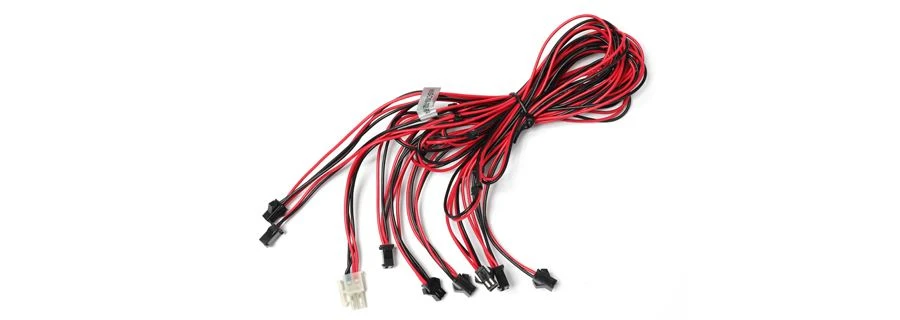
The main features of silicone high temperature terminal wires are high temperature resistance, insulation, flame retardant, acid and alkali resistance, aging resistance, weather resistance, high strength, high modulus, antistatic, and smooth appearance. There are many kinds of them, such as fluoroplastic insulated high temperature wires, silicone rubber insulated high temperature wires, high temperature electronic wires, silicone rubber insulated braided wires, multi-core high temperature cables, PEEK wires and mineral insulated fire-resistant cables. Silicone rubber high-voltage wires, PTFE high-voltage wires and PTFE wires, nylon sheathed wires, mica high-temperature wires, aircraft wax wires, etc.
The quality of silicone high-temperature terminal wires can be seen at a glance from the appearance of the wires and cables. The appearance requirements of silicone high temperature wire are smooth and round, uniform gloss, no visible debris, no mechanical damage, no flattening, no deviation from the core wire (not exceeding the specified deviation), air bubble, slub, twisted shape, obvious particles Wait. It can be seen that the thickness of the sheath has a certain influence on the quality of the silicone high temperature wire. Of course, the thickness of the sheath does not meet the standard, and if the thickness exceeds the standard, it does not meet the standard.
The material performance of silicone high temperature terminal wire is not reflected by the thickness, but according to the standard requirements. If a certain index fails to meet the standard, it will directly affect the quality of the silicone high temperature wire. After the silica gel high temperature wire is laid, it will be energized for a long time to generate heat. The allowable working temperature of the conductor is 70, and the allowable long-term working temperature of the silicone high temperature wire is 180. In summer, the working temperature will rise. These temperatures will radiate through the outer sheath. The thickness of the sheath will increase, and the heat energy will be difficult to dissipate, which will affect the service life of the silicone high temperature wire. Under the action of heat, the insulating layer will undergo a series of physical and chemical changes, losing its original excellent performance, resulting in a significant decrease in insulation performance, or even a short circuit, which affects the normal operation of the unit.
Polyvinyl chloride wire generally has a temperature resistance range of -15-80, while silicone high temperature wire can reach -60-200. Polyvinyl chloride wire has a short service life, generally about two years, poor flexibility, poor aging resistance, and easy to crack in the sun. It is suitable for indoor lamps and household appliances. Polyvinyl chloride wires are relatively hard, with smooth surfaces and high brightness. The cost of the same specification of PVC wire is much lower than that of silicone high temperature wire, the compressive strength is lower than that of silicone wire, and the bending recovery ability of PVC wire is poor. Once bent and folded, it is difficult to restore the original appearance. However, the silicone high temperature wire also has disadvantages, such as poor tear resistance of the sheath and high manufacturing cost.