


Flat rainbow ribbon cable has higher assembly reliability and quality. The cable reduces the hardware required for interconnection, such as the solder joints, relay wires, backplane wires and cables commonly used in traditional electronic packaging, so that the cable can provide higher assembly reliability and quality. Because of the complex multi-system composed of the traditional internal hardware in the assembly, it is easy to appear high component dislocation rate. The cable can be moved, bent, and twisted without damaging the wire, and can comply with different shapes and special package sizes. Its only limitation is volumetric space. Because it can withstand millions of dynamic bends, the cable can be well-suited for continuous movement or regular movement of the interconnection system, becoming a part of the final product function. The solder joints on the rigid PCB are subject to thermo-mechanical stress and will fail after hundreds of cycles.
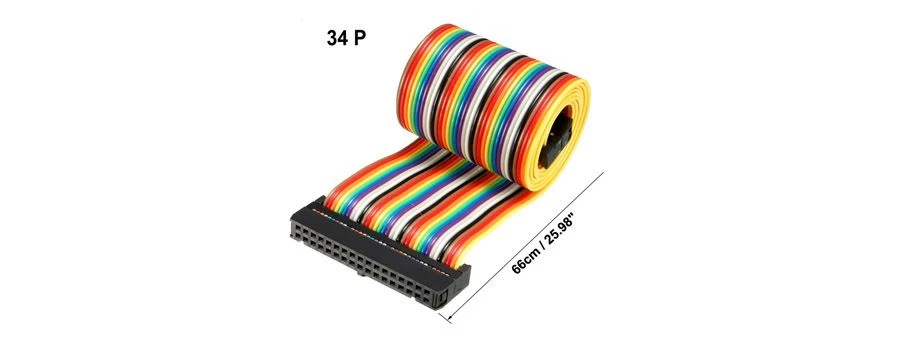
The types of flat rainbow ribbon cable are divided into: adhesive flat rainbow ribbon cable and one-time forming flat rainbow ribbon cable. First of all, we explain UL1007 flat rainbow ribbon cable, UL1061 flat rainbow ribbon cable, UL1571 flat rainbow ribbon cable, UL1015 flat rainbow ribbon cable, these four flat rainbow ribbon cables are adhesive flat rainbow ribbon cables. What is the adhesive flat rainbow ribbon cable? The adhesive flat rainbow ribbon cable is made of UL1007 electronic wire, UL1061 electronic wire, UL1571 electronic wire, and UL1015 electronic wire. A single electronic wire is parallel and side by side. The flat rainbow ribbon cable is divided into UL2651 flat rainbow ribbon cable, which is called the pitch flat rainbow ribbon cable, also known as the UL2651 rainbow cable, and the pitch is divided into 1.27mm, 2.0mm, 2.54, 3.0mm pitch flat rainbow ribbon cable.
Characteristics of flat rainbow ribbon cable:
1. The small flat cable is very thin, even not much larger than the tip of the needle, so it should be operated under the magnifying glass. Homemade magnifying glass workbench.
2. Fix the cable with adhesive tape.
3. Press the cable with the groove blade, fix the blade with tape, press on both sides, and the flat cable is to be welded in the middle.
4. The blade can be ground with a hand saw blade or a shaving blade. The next step is soldering. Use a flat-mouthed electric iron to grind the mouth into a knife edge. Less soldering tin during welding, the welding speed should be faster.